
By Rick Wagaman, Herbal IQ Education & Consulting
For years, I’ve sat across from patients here in Iowa who were simply trying to make sense of cannabis in a system that didn’t make sense to them. They weren’t asking for politics or headlines. They were asking honest, practical questions.
Is this safe? Will it help? Why is this so complicated?
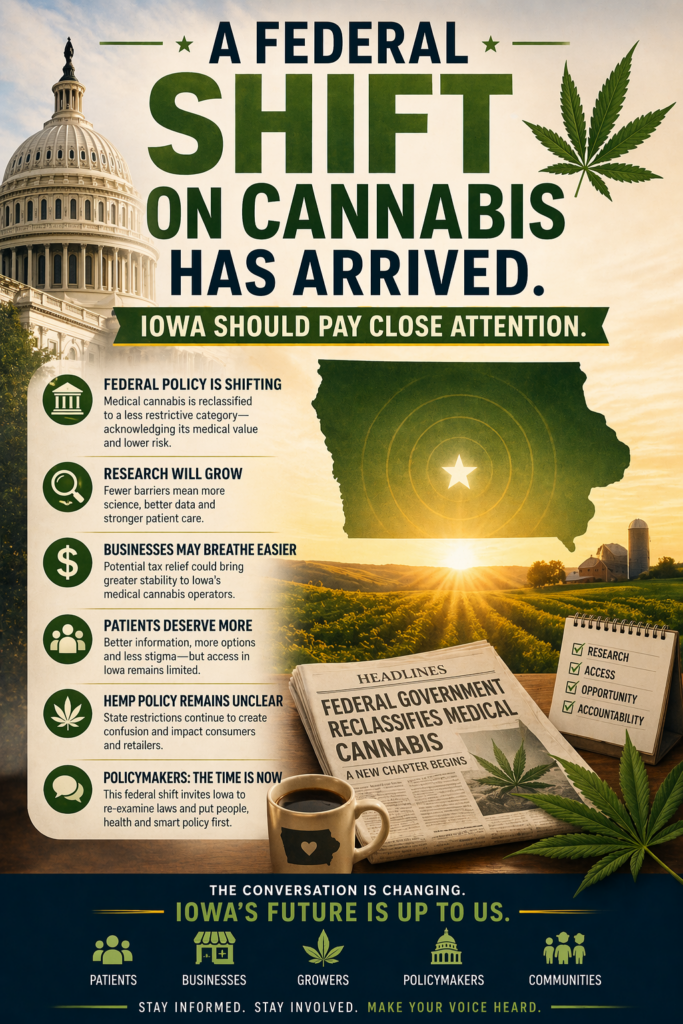
In April 2026, the federal government made a decision that begins to answer those questions in a new way. State-licensed medical cannabis has been reclassified under federal law to a less restrictive category, signaling a formal acknowledgment that cannabis has accepted medical use and a lower abuse potential than previously recognized. For many, this feels like long-overdue progress. But here in Iowa, the reality is more nuanced.
Let’s be clear. This is not legalization. Cannabis remains federally illegal. Recreational use is still prohibited in Iowa. State law continues to define access, structure and limitations. For many Iowans, nothing will feel different tomorrow. Access will still be limited. Costs will remain high. And confusion around what is legal, what is safe, and what is available will still exist.
That does not make this change insignificant. It simply means progress and impact are not always the same thing.
What this decision does is shift the foundation of the conversation. For the first time in decades, the federal government is beginning to align, at least in part, with what patients and clinicians have been saying for years. Cannabis does have medical value. That acknowledgment matters more than it may seem at first glance.
For patients, it opens the door to something that has been missing for far too long. Research. For years, meaningful clinical research has been limited by federal restrictions. As those barriers begin to ease, we should expect better data, clearer dosing guidance, and more informed conversations between patients and healthcare providers. That is a long-term win, even if it does not immediately change access here in Iowa.
For medical cannabis operators, the impact may be more immediate. Federal tax policy has long placed these businesses at a disadvantage, preventing them from taking standard business deductions under IRS code 280E. With this reclassification, that burden may ease for state-licensed medical operators. In a tightly controlled market like Iowa, where margins are thin and scale is limited, that kind of financial relief could mean greater stability and reinvestment into patient care and education.
But the story becomes more complex when we look beyond the medical program.
Iowa’s cannabis landscape is not defined solely by its medical system. Over the past several years, many consumers have turned to hemp-derived cannabinoid products as an accessible alternative. At the same time, state policy has tightened restrictions on those products, narrowing availability and reshaping the retail environment.
This federal change does not resolve that tension.
In fact, it may highlight it.
The federal government is beginning to legitimize medical cannabis, while states like Iowa have taken a more restrictive approach to hemp-derived cannabinoids. One system is moving toward acceptance. The other is becoming more constrained. And consumers are left trying to navigate the space in between.
That disconnect raises important questions about the path forward.
Will Iowa expand its medical cannabis program as federal recognition grows?
How will hemp-derived cannabinoids be defined and regulated moving forward?
And most importantly, will patient access improve in a meaningful and responsible way?
These are not abstract policy questions. They affect real people across our state.
Iowa’s medical cannabis program remains one of the more limited frameworks in the country, with restricted qualifying conditions and tightly controlled product formats. Patients often face barriers not just in access, but in understanding what options truly exist within the system. Many are left navigating uncertainty without clear, consistent guidance.
For policymakers, this moment presents both an opportunity and a responsibility.
The federal government has taken a step toward acknowledging medical cannabis as a legitimate therapeutic option. That shift invites states to re-examine their own frameworks. Are current policies meeting patient needs? Are they aligned with emerging scientific understanding? And how should Iowa balance safety, access and economic opportunity in a changing national landscape?
There are no simple answers. But there is a clear need for thoughtful, informed discussion.
What is certain is that this is not the end of the cannabis policy conversation. It is a transition point. A signal that the federal government is beginning to move, cautiously but meaningfully, toward a different posture on cannabis.
For Iowa, the path forward is still being written.
Patients will continue to seek relief. Businesses will continue to adapt. And the need for clear, evidence-based education will only grow stronger.
I’ve spent years working with individuals and families trying to navigate this space with clarity and confidence. What I’ve learned is simple.
Policy matters. But understanding matters more.
Because when people are informed, they make better decisions for their health, their families, and their future.
That is the work we will continue to do.
Stay Connected
Learn more and follow ongoing updates at: https://herbal-iq.com

