
Most people reach for CBD because they want calm. Better sleep. Less tension. A smoother day.
But here’s the part we don’t talk about enough: calm is not just a feeling. Calm is biology. And when you change biology, you sometimes change things like heart rate and blood pressure, even in healthy people.
That’s exactly why this 2017 study is worth reading. It doesn’t prove CBD is a treatment for hypertension. It doesn’t mean everyone should take CBD for blood pressure. But it does show something important and very teachable:
CBD is physiologically active and the cardiovascular system responds. (pmc.ncbi.nlm.nih.gov)
What the researchers did (simple, clean design)
Researchers enrolled nine healthy male volunteers and used a randomized, placebo controlled, double blind, crossover study design. Translation: each person served as their own comparison.
On one visit participants received 600 mg of oral cannabidiol (CBD). On another visit they received placebo. The researchers measured cardiovascular markers at rest and during stress tests (mental arithmetic, isometric exercise and cold stress). (pmc.ncbi.nlm.nih.gov)
What happened after a single CBD dose
Here’s the headline finding in plain language:
Resting systolic blood pressure dropped by about 6 mmHg after CBD compared with placebo. (pmc.ncbi.nlm.nih.gov)
But the more important lesson is the pattern:
- Systolic BP decreased (~6 mmHg at rest) (pmc.ncbi.nlm.nih.gov)
- Stroke volume decreased (how much blood the heart pumps per beat) (pmc.ncbi.nlm.nih.gov)
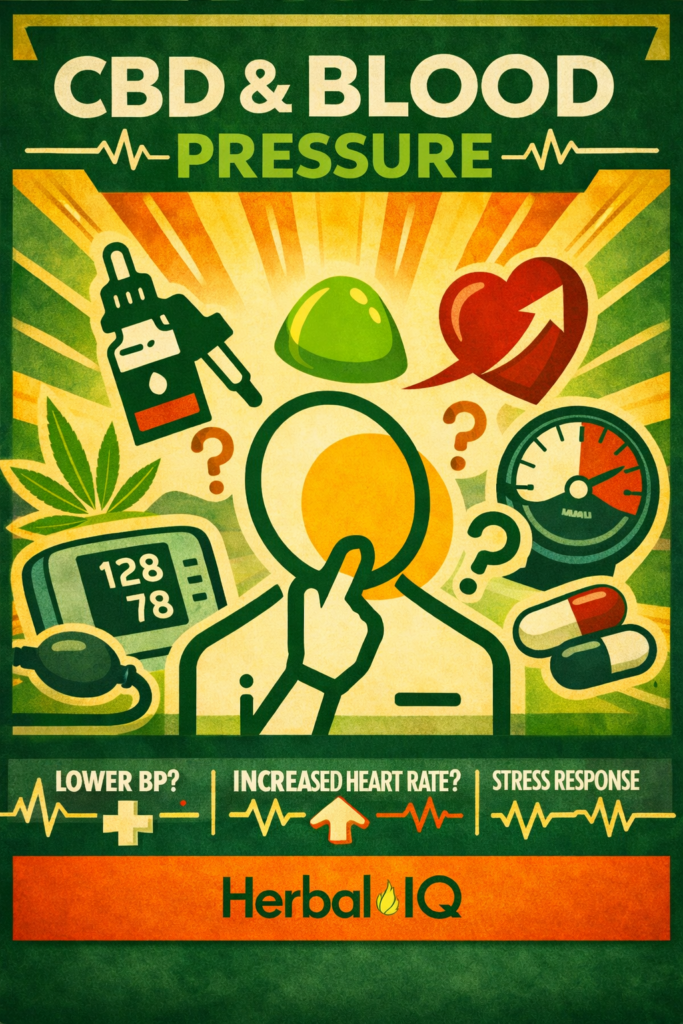
- Heart rate increased, likely as compensation (pmc.ncbi.nlm.nih.gov)
A simple way to remember it:
CBD nudged blood pressure down, and the body responded by tapping the gas pedal on heart rate to keep circulation steady.
That’s not “good” or “bad” by itself. It’s just physiology, and it’s exactly why dose and context matter.
What happened under stress
The study also looked at how the body responded during stress tasks.
The authors report CBD was associated with lower blood pressure around stress exposure and a blunted blood pressure response during cold stress, paired with increased heart rate and changes consistent with reduced vascular resistance. (pmc.ncbi.nlm.nih.gov)
Again, the takeaway isn’t “CBD fixes stress.” The takeaway is:
CBD appears to influence hemodynamics and that influence shows up even during stress challenges.
Dose reality check (this matters) 600 mg is a high single dose. It’s far above what many people take from typical retail tincture servings. That means we should be cautious about translating these findings to everyday use.
This study does not tell us:
- what happens at lower doses
- what happens with long term daily use
- what happens in women, older adults, or people with hypertension
- how formulation or delivery method changes results
All we can responsibly say is what they measured: an acute, high dose changed cardiovascular parameters in healthy men. (pmc.ncbi.nlm.nih.gov)
Practical safety notes (because people will try this anyway)
If you have blood pressure issues, get lightheaded easily, or take medications, this is where being careful matters most.
Consider discussing CBD with a licensed clinician if you use:
- blood pressure medications
- medications that affect heart rate
- sedatives or other CNS active drugs
- complex medication regimens
And if someone chooses to experiment:
start low, go slow, and do not combine “trying something new” with driving or safety sensitive work.
My bottom line as an evidence first educator
I like this paper because it’s a quiet rebuttal to two common myths at once:
- “CBD is basically nothing.”
Nope. It can measurably shift physiology. (pmc.ncbi.nlm.nih.gov) - “One study proves a new use case.”
Also nope. Small studies generate hypotheses. They don’t create clinical guidelines.
The real win here is what it pushes us toward next:
better research using ambulatory blood pressure monitoring, broader demographics, and multiple dose ranges.
CTA: Learn with us
If you want cannabinoid research translated into practical language with the hype stripped out and the nuance left in, become a member at Herbal IQ Education & Consulting.
Members get deeper study breakdowns, safety frameworks, and decision tools that help you think clearly about cannabinoid science in the real world, not just in headlines.
Reference
Jadoon KA, Tan GD, O’Sullivan SE. A single dose of cannabidiol reduces blood pressure in healthy volunteers in a randomized crossover study. JCI Insight. 2017. PMCID: PMC5470879. (pmc.ncbi.nlm.nih.gov)
Disclaimer
Educational content only. Not medical advice. This content does not claim CBD treats or prevents hypertension or any disease. CBD may interact with medications and may affect heart rate and blood pressure. Always follow local laws and consult a licensed clinician for personalized guidance.
Hashtags
#HerbalIQ #CBD #Cannabidiol #BloodPressure #CardiovascularHealth #HypertensionEducation #EndocannabinoidSystem #CannabinoidScience #ClinicalResearch #EvidenceBasedWellness #HealthEducation #PublicHealth
