
The History of Cannabis in the Pharmacopeia
If you want to understand today’s cannabis confusion, start with one fact that surprises a lot of people: cannabis was once an official medicine in the United States Pharmacopeia.
That single detail changes the tone of the conversation. It moves cannabis out of rumor and into the documented history of American pharmacy.
What a pharmacopeia really means
A pharmacopeia is not a wellness blog. It is an official, standard-setting reference for medicines. When a substance is listed, it signals that medical and pharmacy institutions recognize it as a drug preparation with defined characteristics and accepted use at that point in time. So when cannabis appears in the U.S. Pharmacopeia in the 1800s, it is not a cultural footnote. It is a clinical and regulatory milestone.
Before the U.S. Pharmacopeia: a long global medical history
Humans have used cannabis medicinally for thousands of years across multiple civilizations, including ancient Egyptian, Chinese, Indian, Greek, Persian, and Roman contexts. In the 1800s, the Irish physician William O’Shaughnessy documented medicinal cannabis use in India and helped introduce it into Western medical practice, accelerating formal interest in cannabis preparations.
1850: Cannabis becomes an official U.S. medicine
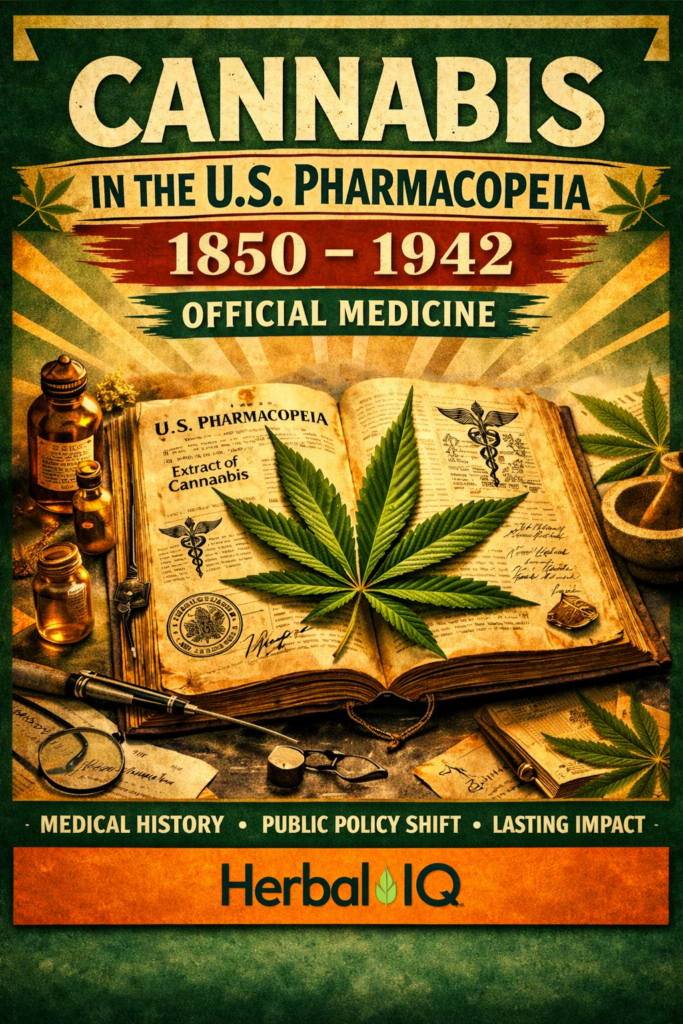
Cannabis was described in the United States Pharmacopeia for the first time in 1850. In the decades that followed, physicians prescribed cannabis preparations and pharmacies dispensed them. In that era, botanical medicines were common in pharmacy practice and cannabis products were manufactured and sold through mainstream channels.
Early 1900s: medical culture shifts away from botanicals
In the early 20th century, American medicine underwent major professional and institutional changes. Training standards tightened, medical practice moved toward laboratory-based models, and standardized pharmaceuticals increasingly replaced many crude botanical preparations. This broader shift made plant-based medicines less central to routine medical care, setting the stage for cannabis to lose institutional support even before it was formally restricted.
1937: the Marihuana Tax Act changes the trajectory
Federal restriction accelerated with the Marihuana Tax Act of 1937. The law imposed administrative burdens and legal risk around prescribing and dispensing cannabis, contributing to declining medical use. Once a substance becomes administratively risky and politically stigmatized, it tends to disappear from routine clinical practice, even before it is fully prohibited.
1942: cannabis is removed from the U.S. Pharmacopeia
After the 1937 Act, cannabis was dropped from the United States Pharmacopeia in 1942. Official listing confers legitimacy. Removal signals the opposite and this event helped shape decades of public and professional assumptions about whether cannabis could be considered a real medicine.
1970 and beyond: prohibition becomes modern federal policy
In 1970, Congress passed the Controlled Substances Act, classifying cannabis as a Schedule I substance at the federal level. That classification asserted no accepted medical use and created long-standing barriers to research. When research is difficult to conduct, evidence accumulates more slowly, which can reinforce the very assumptions used to justify restriction.
Why this history still matters
When people argue about cannabis today, they often talk past each other. One side speaks from modern prohibition language. The other side speaks from modern patient experience. Pharmacopeia history adds a third perspective: institutional memory. Cannabis has been both official medicine and prohibited drug. The real question is not whether the plant is good or bad. The real question is how policy, medical culture and research access shaped what we think we know.
At Herbal IQ, our lane is simple: respect history, respect evidence, and respect real-world complexity.
Call to action
If you want cannabinoid education that connects history, policy, safety, and the latest science without hype, become a member at Herbal IQ Education & Consulting. Membership is where we translate research into practical guidance, build product literacy and keep the conversation honest and human.
References
- UCLA Center for Cannabis and Cannabinoids. History of Cannabis. https://cannabis.semel.ucla.edu/history-of-cannabis/
- Bridgeman MB, Abazia DT. Medicinal Cannabis: History, Pharmacology, and Implications for the Acute Care Setting. P T. 2017. https://pmc.ncbi.nlm.nih.gov/articles/PMC5312634/
- Americans for Safe Access. The History of Cannabis in the United States. https://www.safeaccessnow.org/us_history_of_cannabis
Disclaimer
Educational content only. Not medical advice. This article is historical and educational and does not claim cannabis, CBD, or THC diagnose, treat, cure, or prevent any disease. Always follow local laws and consult a licensed clinician for personal medical deci
