As I’ve been thinking about where the cannabis industry is headed, one thing keeps coming back to me: I’m not sure the next cannabis consumer is going to look much like the consumer our industry has traditionally served.
For years, many of the people entering cannabis businesses already had some familiarity with the plant. They may have consumed cannabis before legalization, understood the effects of THC or at least walked through the door with a general idea of what they wanted. But I think we need to prepare for a different kind of consumer. They may be older, wellness focused, medically curious, taking prescription medications, helping a spouse or parent explore cannabis or simply trying cannabis for the first time. Some may have been interested for years but stayed away because of stigma, legality, uncertainty or simply not knowing where to begin.
When that person finally walks through the door, their first question probably isn’t going to be, “What’s your highest THC product?” It may be something much simpler: “Can you help me understand this?” I think that question represents both an opportunity and a responsibility for all of us working in this industry.
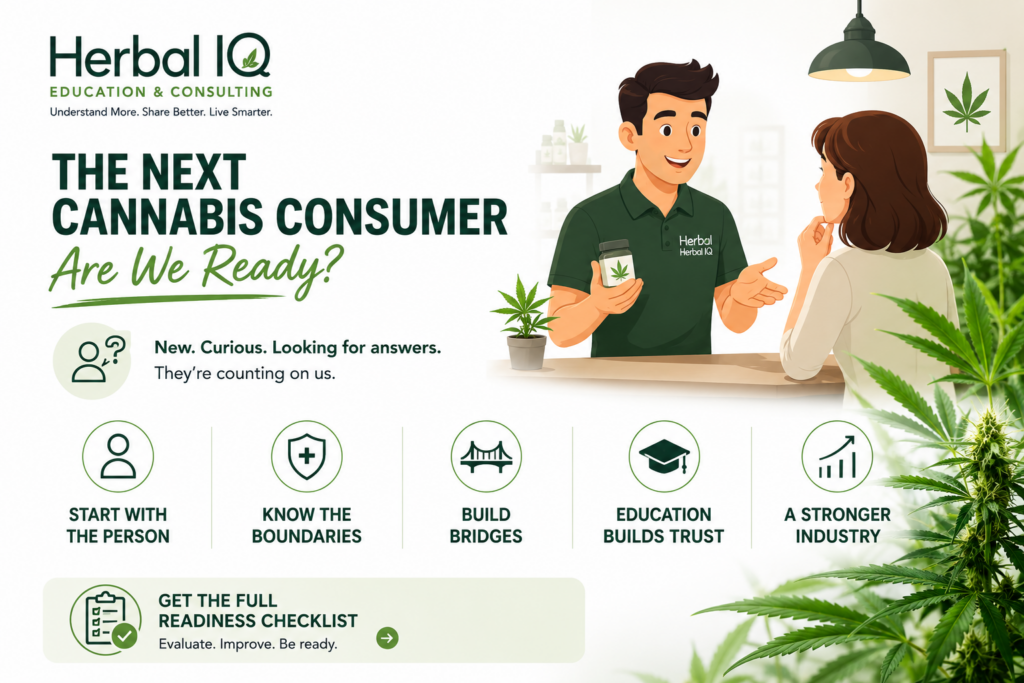
One thing I’ve learned through cannabis education is how quickly we can overwhelm someone who is new to this space. We talk about cannabinoids, terpenes, percentages, milligrams, formulations and delivery methods because those terms have become familiar to us. But imagine hearing all of that for the first time. Sometimes the questions that matter most are much more basic. What is this? What might I reasonably expect? How do I approach it responsibly? How long could the effects last? And where should I turn when my questions become medical? I believe good cannabis education begins by meeting people where they are. Start with the person, not the product.
That also means recognizing that education has boundaries and I think that’s a good thing. Retailers and customer-facing employees can play an incredibly important educational role without becoming healthcare providers. Helping someone understand product formats, cannabinoid content, labels, serving information, onset, duration and general responsible use can be tremendously valuable. But when the question becomes, “What should I take for my medical condition?” or involves prescription medications, contraindications or individualized treatment decisions, we’ve entered a different conversation.
Knowing when to say, “That’s a good question to discuss with your healthcare professional,” shouldn’t be viewed as failing the customer. I think it demonstrates professionalism and builds credibility. We don’t need to blur the boundaries between cannabis businesses, educators and healthcare professionals. We need to build better bridges between them.
There’s also a business side to this conversation. Education shouldn’t simply be viewed as another expense. When employees have good training and reliable resources, they don’t have to reinvent an answer every time a difficult question comes across the counter. When consumers better understand what they’re purchasing and have more realistic expectations, uncertainty can decrease. And when a business is comfortable acknowledging both what it knows and what it doesn’t know, trust can grow. Products can be copied and prices can be matched. Trust is much harder to duplicate.
That thinking is what led me to develop the Next Cannabis Consumer Readiness Checklist through Herbal IQ Education & Consulting as part of our Cannabis Chamber of Commerce Industry Insights conversation. It’s intentionally simple. It gives organizations an opportunity to look at staff knowledge, consumer communication, medical boundaries, referral resources, consistency of education and whether they’re really listening to the questions their customers are asking.
The checklist isn’t about giving anyone a score or pointing out what they’re doing wrong. It’s really meant to start a conversation. Take a few minutes, work through it with your team and pay attention to the boxes you can’t confidently check yet. An unchecked box isn’t necessarily a failure. It may simply show us where the next opportunity to educate, improve and build trust exists.
As this industry continues to mature, I think those are exactly the kinds of conversations we should be having with one another.
