
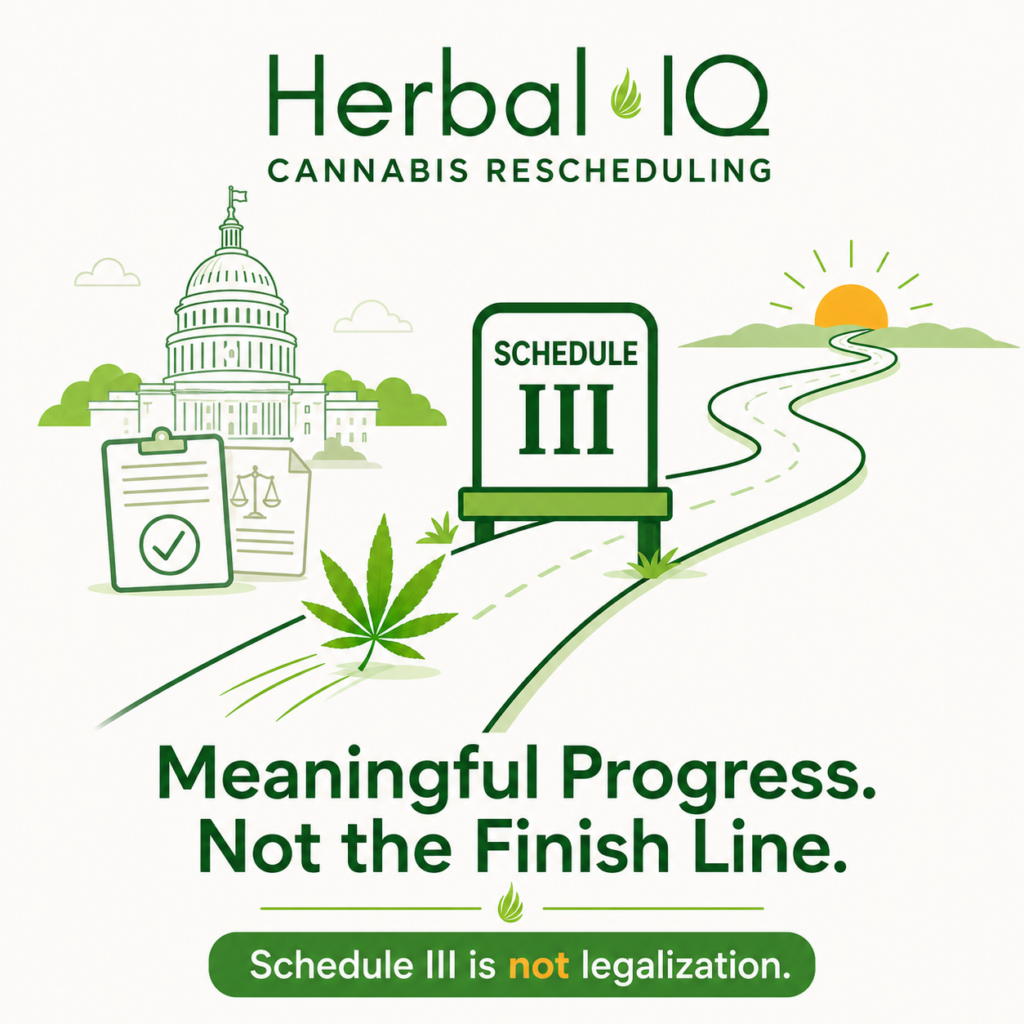
What Schedule III Could Mean for Patients, Professionals, Businesses, and Cannabis Reform
If you have followed cannabis policy for any length of time, you have probably learned that one headline can create ten new questions. Federal cannabis rescheduling is a perfect example. It sounds like legalization. It feels like major reform. And it may bring meaningful changes to medical recognition, research, taxation, and federal regulation. But it does not mean what many people think it means.
Cannabis is not suddenly federally legal. Rescheduling is not the same as decriminalization, and it will not automatically end arrests, erase past convictions, protect every patient, or resolve the conflict between state cannabis programs and federal law. That does not mean rescheduling is unimportant. It means we need to understand it honestly.
For decades, cannabis policy in the United States has existed in a confusing space between science, state law, federal prohibition, public opinion, and the real experiences of patients, families, consumers, professionals, and businesses. Now, as the federal marijuana rescheduling process reaches another important stage, clarity matters more than ever.
The most important takeaway is this: Schedule III may change how the federal government recognizes and regulates cannabis, but it does not make cannabis federally legal.
The implications of cannabis rescheduling will not be the same for everyone. If you are a patient, rescheduling may provide greater federal recognition of cannabis as medicine, but it may not automatically protect your employment, housing, professional license, firearm rights, or access to medical cannabis. If you are a healthcare or wellness professional, the federal acknowledgment of accepted medical use may create new opportunities for education, research, and more informed patient conversations. It does not, however, eliminate the need for careful consideration of dosing, drug interactions, product quality, individual health risks, and clinical boundaries.
If you own or work with a cannabis business, the tax and regulatory implications could be significant. The impact may differ depending on whether the business operates within a medical or adult use market. If you are an employer, the changing federal status of certain cannabis products may eventually affect workplace policies, employee accommodation questions, drug testing practices, and risk management decisions. And if you are an advocate, rescheduling represents movement, but criminal justice reform, record relief, patient protections, descheduling, and broader legalization remain unfinished work.
No matter where you enter this conversation, the headline alone does not tell the whole story.
The Drug Enforcement Administration’s hearing on the proposed movement of marijuana from Schedule I to Schedule III has reached an important procedural milestone. The DEA and organizations opposing rescheduling have submitted their final post hearing briefs. The administrative law judge will now review the testimony and hearing record before issuing a recommendation. The DEA administrator will ultimately make the final agency decision. Any final rule could still be challenged in federal court, meaning the broader rescheduling proceeding is moving forward but is not yet complete.
The federal government’s position is significant. In its final brief, the DEA argued that marijuana no longer meets the legal requirements for placement in Schedule I because it has a currently accepted medical use in the United States and accepted safety when used under medical supervision. The DEA also referenced more than 30,000 practitioners treating over six million patients in 43 U.S. jurisdictions. The agency argued that marijuana’s abuse and dependence profiles more closely align with substances in Schedule III than with those in Schedules I or II.
Regardless of where someone stands on cannabis policy, this represents a remarkable shift. For years, federal policy maintained that cannabis had no accepted medical use. Now the DEA itself is arguing that marijuana no longer belongs in Schedule I. That acknowledgment matters, but it does not answer every question or solve every problem.
The federal Controlled Substances Act places regulated substances into different schedules based partly on accepted medical utility and the potential for misuse and dependence. Schedule I is reserved for substances the federal government considers to have no currently accepted medical use and a high potential for abuse. Schedule III substances are recognized as having accepted medical utility and a lower potential for abuse than substances in Schedules I and II.
Moving marijuana from Schedule I to Schedule III would therefore represent formal federal recognition that cannabis has medical value. That is important for patients, healthcare professionals, researchers, educators, advocates, and organizations that have spent years challenging outdated assumptions about the plant. However, Schedule III substances remain controlled substances. Cannabis would remain regulated under the Controlled Substances Act, and activities permitted under state cannabis laws would not necessarily become federally lawful simply because marijuana changed schedules.
Rescheduling should therefore be understood as a change in federal classification, not the removal of federal control.
In April 2026, the Justice Department issued an order immediately moving two defined categories of marijuana into Schedule III: marijuana contained in FDA approved drug products and marijuana products covered by qualifying state medical marijuana licenses. Other marijuana, including cannabis outside those defined categories, generally remains in Schedule I under the order. Hemp was not included in the change.
This creates an important distinction. A qualifying patient possessing cannabis from a state licensed medical program may now be situated differently under federal policy than an adult purchasing cannabis through a state regulated recreational market. That separation may create opportunities, but it may also create new confusion. Who is protected? Which products qualify? What must a business do to operate within the new federal framework? How will patients know whether their possession and use are protected? What happens when a person travels between states or enters federal property?
These are not minor details. They will influence how patients, healthcare professionals, businesses, employers, regulators, and law enforcement agencies interpret the developing policy.
Perhaps the most important symbolic and policy change is federal acknowledgment that cannabis has a currently accepted medical use. That does not mean every cannabis product has been approved by the Food and Drug Administration. Rescheduling and FDA approval are separate processes. Moving cannabis to Schedule III would not automatically turn state regulated cannabis products into FDA approved prescription medications or require all cannabis to be sold through pharmacies.
Still, federal recognition of medical use may help move the public conversation away from the outdated claim that cannabis has no therapeutic value.
One of the clearest business implications involves Section 280E of the Internal Revenue Code. Section 280E prevents businesses trafficking in Schedule I or Schedule II controlled substances from deducting many ordinary business expenses. The April 2026 order clarified that qualifying state licensed medical marijuana businesses would no longer be subject to the 280E deduction restriction for covered medical cannabis activities. At this time, that change applies to state authorized medical cannabis activity and not automatically to adult use cannabis businesses.
This could provide meaningful financial relief to qualifying medical cannabis operators. However, it may also deepen the regulatory and economic separation between medical and adult use markets.
Research may also benefit. Researchers can already study cannabis, but federal requirements have historically made clinical cannabis research unnecessarily difficult. The April 2026 order clarified that researchers may obtain state authorized cannabis products for scientific research without civil or criminal liability solely because those products came from a state licensed source rather than a separate DEA registered bulk manufacturer.
This could help researchers study products that more closely resemble those patients are actually purchasing and using in regulated markets. That is an important step. But rescheduling alone will not eliminate every federal research barrier. Some cannabis specific restrictions are established in federal statutes and regulations that may require separate congressional action.
Rescheduling may eventually influence employment policies, workplace accommodations, banking relationships, firearms restrictions, subsidized housing rules, insurance coverage, federal benefits, and professional licensing. But the effects will vary. Some federal restrictions are based specifically on the use of a Schedule I substance. Moving cannabis to Schedule III could provide a legal basis for challenging certain restrictions. Other consequences are created by marijuana specific statutes, agency policies, or employment regulations and will not disappear automatically.
For example, federal guidance continues to prohibit medical cannabis use by certain safety sensitive transportation workers despite the recent changes affecting qualifying medical marijuana. This is why patients and professionals should be cautious about assuming that a change in scheduling creates universal protection.
This may be the most important part of the conversation. Rescheduling will not automatically legalize cannabis nationwide. It will not remove marijuana from the Controlled Substances Act. It will not protect every state licensed cannabis business, end federal marijuana possession and trafficking penalties, release people incarcerated for marijuana offenses, expunge past cannabis convictions, restore voting rights, employment opportunities, housing access, professional licenses, or other rights lost because of a cannabis conviction. It will not resolve every conflict between state cannabis programs and federal law, and it will not require states that prohibit cannabis to legalize it.
Many federal marijuana offenses and penalties are established through statutes that are not directly tied to cannabis being in Schedule I. Changing those laws generally requires congressional action. That reality was also a central theme of the recent Drug Policy Alliance panel discussion. Panelists repeatedly emphasized that rescheduling may change the tone and direction of federal cannabis policy, but it cannot deliver the broader reforms only Congress can enact.
Rescheduling can move the conversation forward. It cannot finish the work.
The structure of the DEA rescheduling hearing also raised serious questions about representation. According to reporting and the firsthand account of Cat Packer from the Drug Policy Alliance, the DEA selected only parties opposing the proposed rescheduling as designated participants in the hearing. Organizations representing reform advocates, patients, researchers, regulators, consumers, and people affected by cannabis criminalization were not selected as participating parties.
Administrative hearings are expected to test the government’s position, and opposing viewpoints deserve to be considered. But the exclusion of reform organizations raises a larger and more human question: Where were the patients, families, researchers, regulated operators, advocates, and communities that have experienced the effects of cannabis prohibition?
The hearing examined medical use, public safety, federal enforcement, drug testing, regulatory standards, and the potential for misuse. But according to Packer’s account, it gave far less attention to arrests, convictions, incarceration, family disruption, racial disparities, and the long term collateral consequences created by marijuana prohibition.
Those voices matter because cannabis policy is not only a legal, scientific, or regulatory discussion. It is a human discussion.
Recognizing cannabis as medicine while continuing to criminalize many people who possess or use it creates an uncomfortable contradiction. A patient may use cannabis through a qualifying state medical program while another adult using a similar product may still face criminal, employment, housing, or professional consequences. A state licensed medical cannabis business may receive federal tax relief while an adult use business operating legally under state law may continue to face Section 280E. The federal government may recognize accepted medical use while people remain incarcerated or burdened by convictions involving the same plant.
That is why rescheduling cannot be treated as the end of the conversation. It is a significant policy shift. It is also a reminder of how much work remains.
Rescheduling and descheduling are often used interchangeably, but they describe very different policy outcomes. Rescheduling moves cannabis from one category of the Controlled Substances Act to another. Descheduling removes cannabis from the Controlled Substances Act entirely.
Schedule III could create meaningful improvements in federal medical recognition, research access, taxation, and regulatory treatment. But as long as cannabis remains scheduled, it remains under federal controlled substance law. NORML argues that descheduling is necessary to give states authority comparable to the authority they currently exercise over alcohol and tobacco, neither of which is scheduled under the Controlled Substances Act.
People may reasonably disagree about what the future federal cannabis framework should look like. But we should be honest about the limitations of the current process.
Rescheduling is reform. It is not comprehensive reform.
So what should patients, professionals, businesses, and organizations do now? The first step is to avoid making assumptions. Patients should not assume that all cannabis use is now federally legal or protected. Businesses should not assume that Schedule III automatically resolves banking, taxation, licensing, transportation, employment, interstate commerce, or regulatory concerns.
Healthcare and wellness professionals should recognize the importance of federal acknowledgment while continuing to evaluate cannabis through the lenses of available evidence, patient safety, dosing, drug interactions, product quality, and individual risk. Employers should review policies carefully instead of relying on outdated language or assuming that every form of marijuana use must be treated identically. Advocates should continue pressing for reforms involving criminal penalties, expungement, incarceration, patient protection, employment, housing, banking, research access, and the continuing conflict between federal and state laws.
Most importantly, everyone involved should seek reliable information. Cannabis policy is changing quickly, and headlines rarely tell the whole story.
As federal cannabis policy continues to evolve, what matters most to you? Is it patient access? Better medical research? Business stability? Clearer workplace policies? Criminal justice reform? Or better public education that helps people understand what is really changing?
There is room for different answers. But meaningful reform begins with an informed public and an honest conversation.
The federal government’s evolving position on cannabis represents progress. Recognizing that marijuana has accepted medical use is not a small development. It challenges decades of federal policy and gives greater credibility to the experiences of patients, clinicians, researchers, and educators who have long understood that cannabis does not belong in a category reserved for substances considered to have no accepted medical value.
But progress should not be confused with completion. Schedule III will not erase the past. It will not resolve every state and federal conflict. It will not automatically protect every patient, consumer, employee, business, or healthcare professional. And it will not replace the need for Congress to address comprehensive federal cannabis reform.
At Herbal IQ Education & Consulting, our goal is to help people move beyond the headline and understand what cannabis policy developments mean in the real world. We provide evidence informed cannabis education, professional training, policy interpretation, and practical guidance for healthcare adjacent teams, aging and wellness organizations, educators, employers, regulated cannabis and hemp stakeholders, advocates, and community groups.
Are you trying to understand what federal cannabis rescheduling could mean for your organization, employees, patients, customers, or community? Let’s start the conversation.
Visit www.herbal-iq.com or call 515-657-3739 to learn more about educational programs, professional training, and cannabis policy support.
This article is provided for educational purposes and should not be interpreted as legal, tax, regulatory, or medical advice. Cannabis laws and policies continue to change. Readers should consult appropriately qualified professionals regarding their individual circumstances.
About the Author
Rick Wagaman, MS, Medical Cannabis Science and Therapeutics, is the founder of Herbal IQ Education & Consulting. He earned his Master of Science in Medical Cannabis Science and Therapeutics from the University of Maryland, Baltimore.
Through Herbal IQ, Rick helps professionals, organizations, policymakers, industry stakeholders, and communities better understand cannabis science, policy, safety, responsible use and implementation. His work is grounded in evidence, practical education, public health awareness, and the belief that people make better decisions when they are given clear and honest information.
CannabisRescheduling #ScheduleIII #FederalCannabisReform #MedicalCannabis #CannabisPolicy #CannabisEducation #CannabisAdvocacy #DrugPolicyReform #CannabisJustice #CannabisResearch #EvidenceBasedCannabis #PatientEducation #CannabisBusiness #HerbalIQ #HerbalIQEducation

