
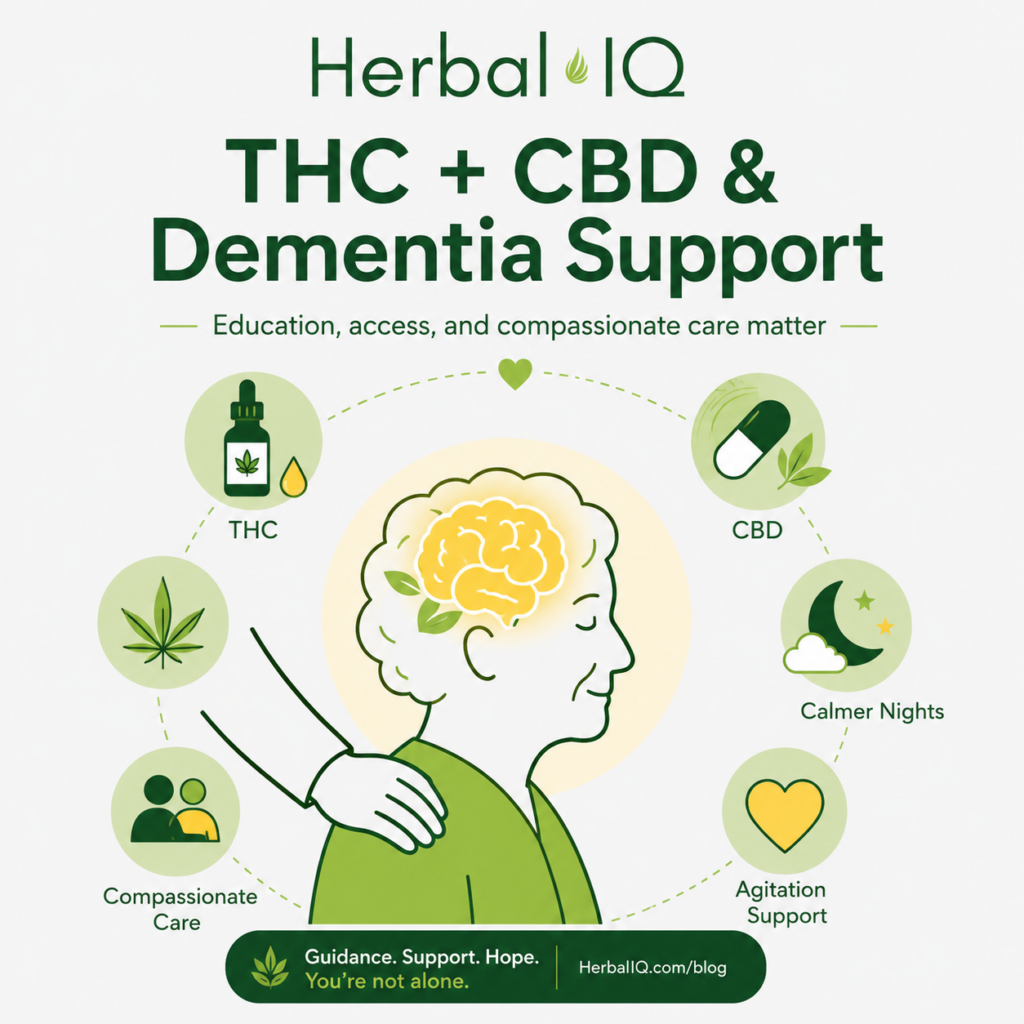
There are some cannabis stories that make you slow down for the right reasons. Not because they prove everything. Not because they give us permission to overstate the science. But because they remind us why medical cannabis access, research and education matter in the first place.
The recent study making headlines around THC, CBD and agitation in people living with Alzheimer’s disease or other forms of dementia is one of those stories. If you have ever cared for someone with dementia, worked in senior care, supported a family through hospice, or watched a loved one become restless, fearful, confused, or unable to settle, you understand this is not an abstract topic. Dementia-related agitation can be heartbreaking. It can look like pacing, yelling, irritability, emotional distress, aggression or simply a deep uneasiness that a person can no longer explain clearly.
The study discussed a specific oral formulation containing both THC and CBD for people with Alzheimer’s disease or other dementia who were experiencing clinically significant agitation. The reported results were encouraging, with many participants in the treatment group showing improvement compared with placebo. That is meaningful, especially because agitation is not just a “behavior problem.” It can be connected to fear, pain, poor sleep, anxiety, overstimulation, medication side effects, infection, constipation, hunger or distress that the person may not be able to communicate.
This is not a story about cannabis curing Alzheimer’s. It is a story about whether carefully studied cannabinoid formulations may help reduce distress, support comfort and give families a little more peace in one of the hardest seasons of care.
This does not mean THC or CBD reverses dementia. It does not mean a retail gummy, hemp oil, edible, tincture, or dispensary product will create the same result. It does not mean families should experiment without clinical guidance. What it does mean is that a specific cannabinoid formulation, studied in a specific population, showed a signal that deserves serious follow-up.
To me, this is exactly where the medical cannabis legalization conversation becomes more important. As medical cannabis access expands across the country, and as Iowa’s medical cannabidiol program enters a new phase of expanded access, the question should not only be, Can more people access cannabis? The better question is, “Can patients, caregivers, clinicians, senior care teams and families access cannabis education that is accurate, practical, and safe?”
Because medical cannabis legalization without education can still leave people guessing. And guessing is not good enough when we are talking about older adults, dementia, hospice care, complex medication routines, fall risk, cognitive impairment, sedation and family decision-making.
This is why cannabis policy and cannabis education need to grow together. Medical cannabis access can create opportunity, but education is what helps turn access into safer, more informed decisions. Families need support. Clinicians need resources. Senior care professionals need practical tools. Cannabis professionals need responsible language. Policymakers need to understand that public health is not only about restriction. Public health is also about education, standards, product quality and implementation that actually protects people.
As medical cannabis access expands in Iowa and across the country, more families will be asking about THC, CBD, Alzheimer’s disease, dementia agitation, sleep, anxiety, pain and end-of-life comfort. The public health question is no longer whether people will ask. From my experience, they already are. The real question is whether they will get accurate cannabis education from trained professionals or confusing answers from marketing, social media and product labels.
One of the most important points in this conversation is product specificity. A THC/CBD formulation used in a clinical study is not the same as a random edible, a retail CBD tincture, a high-THC product or an online hemp product. The dose matters. The THC-to-CBD ratio matters. Route of administration matters. Onset and duration matter. Contaminant testing matters. Medication interactions matter. Caregiver monitoring matters. In dementia care, those details are not fine print. They are safety considerations.
It is also important not to confuse three things:
- Do not confuse symptom support with disease modification. The research discussed here is about agitation, comfort, and distress, not stopping or reversing dementia.
- Do not confuse a clinical formulation with a retail product. Dose, ratio, testing, route, consistency, and monitoring all matter.
- Do not confuse access with guidance. Medical cannabis legalization improves pathways, but education determines whether those pathways are used safely.
For caregivers, I think the most helpful takeaway is this: do not be afraid to ask informed questions, but do not try to navigate this alone. If agitation is showing up, it is important to first ask what might be underneath it. Is the person in pain? Are they constipated? Could there be an infection? Are medications contributing? Is sleep disrupted? Are they overstimulated, hungry, anxious or uncomfortable? Cannabis should never be treated as a shortcut around good clinical care.
For clinicians and senior care professionals, I think this research is a reminder that more patients and families are going to ask about THC, CBD, Alzheimer’s disease, dementia agitation, sleep, anxiety, pain and end-of-life comfort. Avoiding the conversation will not stop people from seeking information. It may simply push them toward less reliable sources. The goal is not for clinicians to become cannabis salespeople. The goal is informed, nonjudgmental and safety-first guidance.
A better conversation might sound like, “What are you hoping cannabis will help with?” or “Is the concern agitation, sleep, pain, appetite, anxiety or distress?” It might include questions about THC exposure, current medications, fall risk, sedation, confusion, cardiovascular concerns, and how the family will track benefit or harm. That type of conversation does not promote cannabis. It promotes safety.
Here in Iowa, where medical cannabis access has historically been limited, expanded medical cannabidiol access is a meaningful step. But more access alone is not enough. If Iowa continues evolving its medical cannabis program, Alzheimer’s and dementia care should be part of the conversation. Not because cannabis is a cure, but because families are already looking for help, and they deserve something better than silence, stigma, or sales pitches.
My Herbal IQ takeaway is simple: this research gives me hope, but not the reckless kind. It gives me the kind of hope that says we should study cannabinoids seriously, regulate medical cannabis thoughtfully and educate people honestly. For people living with dementia and the families who love them, even a little more peace matters. A calmer evening matters. A safer care plan matters. A better-informed caregiver matters. A clinician willing to have the conversation matters.
Where Herbal IQ is coming from.
We believe cannabis education should be rooted in science, guided by compassion and honest enough to say both what we know and what we do not know yet. If cannabinoids can help support comfort and reduce agitation in carefully selected patients under clinical guidance, that is not a small thing. It could mean more dignity in a difficult season. And sometimes dignity, comfort and peace are the outcomes that matter most.
If this topic connects with you personally or professionally, Herbal IQ can help you take the next step. Whether you are a caregiver trying to ask better questions, a clinician preparing for patient conversations, a senior care team wanting staff education, a cannabis professional trying to communicate responsibly, or a policymaker thinking about medical cannabis legalization and public health, we can help translate the science into clear, compassionate, real-world guidance.
Reach out to Herbal IQ to learn more, request a training, or become a member for deeper study breakdowns, product literacy tools, and evidence-first cannabis education. You do not have to navigate this alone. The science is complex, but the conversation can be clear.
References
Marijuana Moment. THC and CBD From Marijuana Reduces Agitation in 9 Out of 10 People With Alzheimer’s or Other Dementia, Study Shows. July 2026.
Alzheimer’s Association. Alzheimer’s Association International Conference coverage of the LiBBY study.
Iowa Legislature. HF 990 bill history and medical cannabidiol program updates.
Governor of Iowa. Gov. Reynolds acts on final bills of 2026 legislative session.
de Morais Cury R, et al. A randomized clinical trial of low-dose cannabis extract in Alzheimer’s disease. Journal of Alzheimer’s Disease. 2025.
Hermush V, et al. Effects of rich cannabidiol oil on behavioral disturbances in patients with dementia. Frontiers in Medicine. 2022.
Outen JD, et al. Cannabinoids for Agitation in Alzheimer’s Disease. American Journal of Geriatric Psychiatry. 2021.
Tufts Medicine. Study: Synthetic THC May Reduce Agitation in Patients with Alzheimer’s Dementia. 2024.
Alzheimer’s Association. What is Dementia?
Alzheimer’s Society. Cannabis, CBD oil and dementia.
Disclaimer
Educational content only. Not medical advice. This article does not claim that cannabis, THC, CBD, or cannabinoid products diagnose, treat, cure, prevent, stop, slow, or reverse Alzheimer’s disease or dementia. Cannabinoids may cause impairment, sedation, dizziness, confusion, and drug interactions, and may increase fall risk in older adults. Families should consult a licensed clinician before considering cannabinoid products, especially for individuals with dementia, hospice care needs, cognitive impairment, cardiovascular conditions, complex medication routines, or frailty. Always follow local laws.
HerbalIQ #MedicalCannabis #AlzheimersEducation #DementiaCare #CannabinoidScience #THC #CBD #IowaMedicalCannabis #CannabisLegalization #SeniorCare #CaregiverSupport #PalliativeCare #CannabisResearch #HealthEducation #EvidenceBased #PublicHealth

