
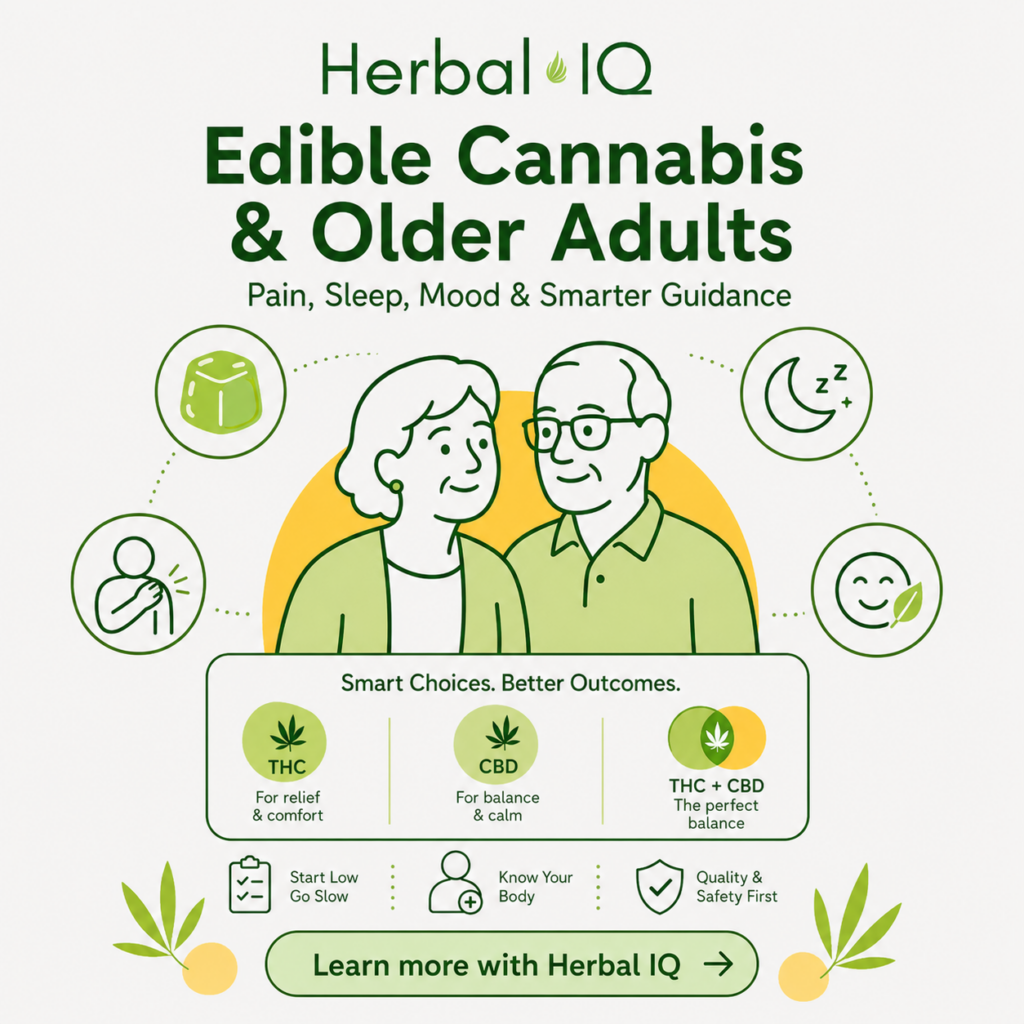
What a new JAMA Network Open study teaches us about pain, sleep, mental health and better guidance.
The Story Behind the Study
There is a quiet shift happening in cannabis and it is not just younger adults driving it.
More older adults are exploring edible cannabis products for pain, sleep, anxiety, mood and overall quality of life. That should not surprise anyone who has spent time listening to people in their 60s, 70s or 80s.
Many are not looking to “get high.” Many are not chasing a trend. Many are simply tired.
Tired of poor sleep. Tired of pain that changes how they move. Tired of medications that help one problem but create another. Tired of feeling like their options are either limited, confusing or poorly explained.
That is why this JAMA Network Open study matters. It does not frame older adults as careless cannabis consumers. It listens to them as thoughtful people trying to solve real problems. And honestly, that is where better cannabis education should start.
What the Study Looked At
The study explored why adults age 60 and older in Colorado were interested in purchasing edible cannabis products for sleep, pain or mental health related symptoms. Researchers interviewed participants before they purchased one of three product types:
- CBD dominant edible products
- THC dominant edible products
- Combination THC and CBD edible products
This was a qualitative study, which means the value is not just in numbers. The value is in understanding motivation, hesitation, decision making, and the real-world questions people bring with them when they consider cannabis.
That matters because cannabis education is not only about pharmacology. It is also about people, values, fears, goals, and lived experience.
Key Findings in Plain Language
The study included 169 adults age 60 and older, with a mean age of 70.8 years. Most participants selected THC and CBD combination products, followed by CBD dominant products and then THC dominant products.
- 57.5% selected a THC and CBD combination product
- 28.7% selected a CBD dominant product
- 13.8% selected a THC dominant product
The main motivations were avoiding pharmaceuticals, feeling like other options had been exhausted, dealing with new or worsening age-related symptoms and being influenced by evidence or claims of benefit. The most common concern for THC-containing products was impairment or unwanted psychoactive effects. For CBD products, the most common concern was whether the product would actually work.
What Older Adults Were Trying to Solve
They wanted alternatives to pharmaceuticals
This was one of the biggest takeaways. Many participants were not anti-medicine. They were concerned about side effects, long term use, drug burden and the way certain medications made them feel.
That distinction matters. There is a big difference between rejecting medicine and wanting more options. Many older adults are not looking for a replacement for healthcare. They are looking for a more complete conversation.
They had already tried other options
Another common theme was exhaustion. Participants talked about trying other approaches first, including over the counter medications, prescriptions, supplements, therapies, lifestyle changes, and other strategies.
Cannabis was not always their first stop. For many, it was closer to, “I have tried a lot, and I am still looking.”
That should make healthcare professionals pause. When patients are exploring cannabis, it may be because they feel unheard, unresolved, or unsupported in other parts of care.
Their symptoms were changing with age
Pain, sleep disruption, anxiety, mood changes and reduced physical comfort showed up again and again. These are not small issues. They affect independence, relationships, movement, confidence and quality of life.
When an older adult says, “I just want to sleep better” or “I want to move with less discomfort,” that is not a casual wellness goal. That is a daily life issue.
Why Product Choice Matters
One of the most interesting findings was that most participants did not choose THC alone.
The largest group selected combination THC and CBD products. The next largest group selected CBD dominant products. THC dominant products were selected least often.
That tells us something important: older adults are often trying to balance potential benefit with concern about impairment. They are asking practical questions:
- Will this help me sleep?
- Will I feel too altered?
- Will I be able to function tomorrow?
- Will this interact with my medications?
- How much is too much?
- How do I know if THC, CBD, or both are responsible for what I feel?
These are not unreasonable questions. They are exactly the questions responsible cannabis education should answer.
The THC Concern: Impairment Is Not a Small Detail
For THC containing products, one of the most common concerns was unwanted psychoactive effects or functional impairment.
That is especially important in older adults because impairment is not just about feeling uncomfortable. It may raise concerns around:
- Driving
- Falls and balance
- Confusion or next day grogginess
- Medication interactions
- Anxiety, paranoia, memory, and cognition concerns
This does not mean THC has no place in older adult cannabis conversations. It means THC should be approached with respect, patience and better guidance.
A phrase I often come back to is simple: Start low. Go slow. Stay curious. Keep notes.
That is not a slogan. That is harm reduction.
The CBD Concern: “What If It Does Not Work?”
CBD dominant products were often viewed as attractive because they do not produce the same intoxicating effect associated with THC. But the concern was different.
For CBD, the common worry was uncertainty around effectiveness.
That is very real. Many people are willing to try CBD because it feels approachable, but they also wonder whether they are paying for something meaningful or something mostly driven by marketing.
This is where product literacy matters. CBD education should include:
- Product quality and certificate of analysis
- Dose consistency
- Route of administration
- Time to onset and expected effect window
- Potential drug interactions
- Realistic expectations
CBD is not “nothing,” but it is also not magic. Education helps people live in that middle ground.
Combination Products: Appealing, but Confusing
Combination THC and CBD products were popular because participants believed they might offer complementary effects. That makes sense. Many people have heard about the “entourage effect” or the idea that cannabinoids may work differently together than alone.
But the study also identified a challenge: people were unsure how to interpret ratios or determine what product was right for them.
That is one of the biggest gaps in the cannabis marketplace.
A 1:1 product, a 5:1 product, a 20:1 product and a THC dominant edible are very different experiences for many people. Yet most consumers are handed a label and expected to make sense of it on their own.
For older adults, that is not good enough.
Why Clinicians Need to Be Part of the Conversation
The study’s conclusion is especially important for healthcare professionals. Older adults are increasingly turning to cannabis for symptom management and health systems need to understand their motivations and concerns so clinicians can provide better counseling and resources.
This is the part I hope medical professionals really sit with.
If clinicians do not bring up cannabis, many patients still will. They may just bring the question to a friend, a store, a website or a social media group instead.
That does not mean every clinician needs to recommend cannabis. It means clinicians should be prepared to have informed, nonjudgmental conversations.
A better clinician conversation might sound like:
- What are you hoping cannabis will help with?
- What product are you considering?
- Is there THC in it?
- What medications are you currently taking?
- Are you worried about impairment or falls?
- Are you using it for sleep, pain, mood, or something else?
- How will we know if it is helping?
That kind of discussion does not promote cannabis. It promotes safety.
What This Means for Retailers and Cannabis Professionals
For cannabis retailers, educators and industry professionals, this study should be a wake-up call.
Older adults are not a side audience. They are one of the most important groups seeking guidance, and they often arrive with legitimate medical concerns, medication complexity and high stakes around safety.
That means education has to be better than “this one is good for sleep.”
Responsible guidance should include:
- Clear onset and duration expectations for edibles
- THC caution and impairment education
- CBD expectations without overpromising
- Medication interaction awareness
- Encouragement to involve a clinician
- Product testing and labeling literacy
- Simple tracking tools for dose and effect
This is where the cannabis industry can either build trust or lose it.
My Herbal IQ Takeaway
This study confirms what many of us already see in the real world: older adults are not simply experimenting. They are problem solving.
They are weighing relief against risk. They are trying to avoid unwanted side effects. They are trying to remain functional, independent and engaged in their lives.
That deserves respect. It also deserves better education.
Cannabis is not a one-size-fits-all answer for pain, sleep, anxiety or mood. But it is becoming part of the conversation for many older adults. The question is whether we are going to leave them to figure it out alone or whether we are going to build the kind of education that helps them make informed, safer decisions.
At Herbal IQ, that is the mission.
Practical Questions to Ask Before Using Edible Cannabis
If an older adult is considering edible cannabis, here are a few practical questions worth asking:
- What symptom am I trying to support?
- Is the product CBD dominant, THC dominant, or a combination?
- How many milligrams of THC and CBD are in each serving?
- How long should I wait before taking more?
- Could this interact with my medications?
- Could this increase fall risk, dizziness, or next day impairment?
- Should I talk with my clinician first?
- How will I track whether it is helping?
That last question is important. If you cannot track it, it is hard to know whether it is truly working.
Call to Action: Learn More With Herbal IQ
If you are a clinician, caregiver, retailer, or older adult trying to better understand cannabis for pain, sleep, mood, or wellness, Herbal IQ is here to help.
We translate cannabis research into plain language, practical guidance and responsible education you can actually use.
Reach out to Herbal IQ to learn more, request a training, or become a member for deeper study breakdowns, product literacy tools and evidence-first cannabis education.
You do not have to navigate this alone. The science is complex, but the conversation can be clear.
References
Delaney RK, Watt MH, Stanger M, et al. Edible Cannabis and Pain, Sleep, and Mental Health Management in Older Adults. JAMA Network Open. 2026;9(5):e2611718. doi:10.1001/jamanetworkopen.2026.11718.
Article link: https://jamanetwork.com/journals/jamanetworkopen/fullarticle/2848773
Disclaimer
Educational content only. Not medical advice. This article does not claim cannabis, THC, CBD, or edible cannabis products diagnose, treat, cure, or prevent any disease. Cannabis may cause impairment and may interact with medications. Older adults should consult a licensed clinician before using cannabis, especially if they take medications, have fall risk, cognitive concerns, cardiovascular conditions, or other health considerations. Always follow local laws.
#HerbalIQ #CannabisEducation #OlderAdults #MedicalCannabis #CBD #THC #Edibles #CannabinoidScience #PainEducation #SleepHealth #MentalHealthEducation #Geriatrics #PublicHealth #EvidenceBased

