Hi friends,
Every now and then, a cannabis study comes across my desk that makes me stop for a moment and say, this is worth paying attention to.
This new study on CBD and melanoma research is one of those moments.
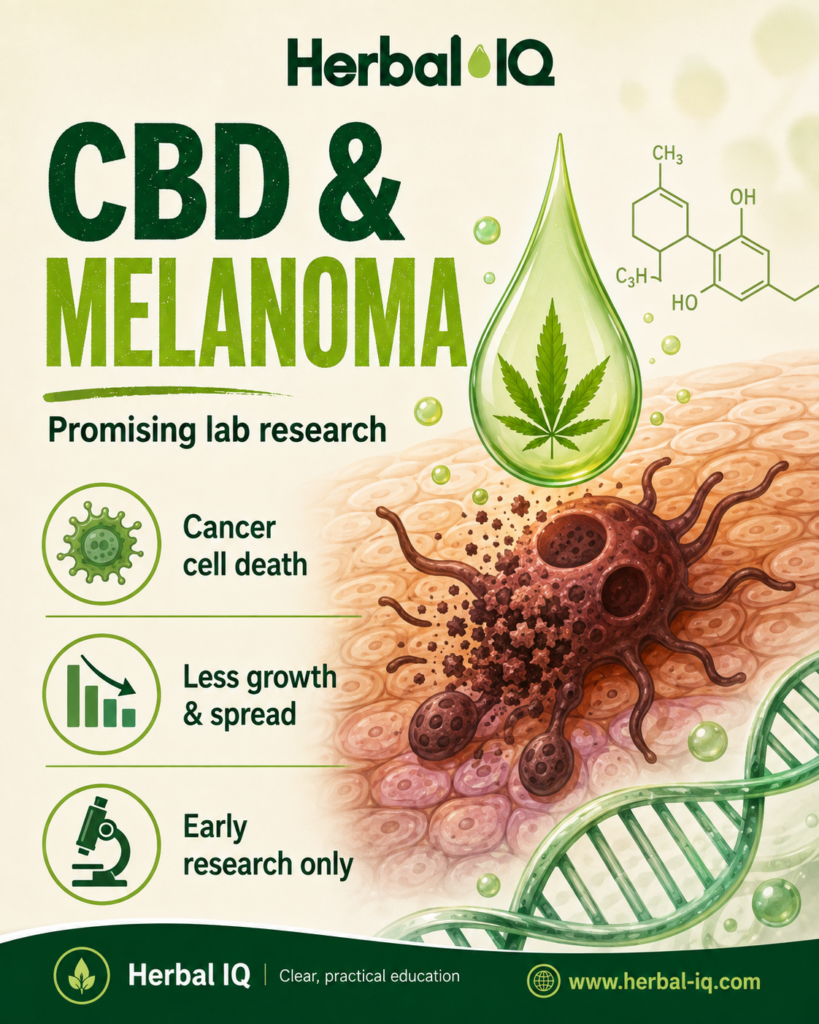
A 2026 paper published in Phytomedicine looked at whether cannabidiol, better known as CBD, could influence melanoma progression. The researchers found that CBD triggered melanoma cancer cell death, slowed melanoma cell growth and invasion in lab models, and reduced the spread of melanoma cells to the lungs in a mouse model. Even more interesting, the study identified a specific epigenetic pathway involving PPARγ, TET1, and LRSAM1 that may help explain how CBD was working at the molecular level.
This study does not prove that CBD treats melanoma in humans. It does not mean CBD cures cancer. It does not mean someone should replace oncology care with CBD, cannabis, hemp products, oils, gummies, topicals or supplements.
What it does mean is that researchers found a biologically interesting anti-melanoma signal in preclinical models. And that signal deserves more research, more conversation and more responsible education.
Melanoma is one of the most serious forms of skin cancer because of its ability to spread. While melanoma represents a smaller percentage of skin cancer cases overall, it is responsible for a large share of skin cancer deaths. Modern oncology has made significant progress with immunotherapy and targeted therapies, but advanced melanoma can still be complicated by treatment resistance, relapse, side effects and differences in how patients respond.
That is why new mechanisms matter.
This does not mean every early-stage laboratory finding will become a future treatment. Most do not. But when researchers identify a pathway that may influence cancer cell survival, spread, or death, it gives science another question to pursue. And in cancer research, good questions matter.
The part of this study that really stands out to me is the epigenetic mechanism. Epigenetics can sound complicated, but here is the simple version: your DNA is like a book, and epigenetics is like the highlights, bookmarks, sticky notes, and crossed-out sections that influence which parts of that book get read. In cancer, those reading instructions can become disrupted. Genes that should help control abnormal cell growth may get quieted, while other signals that allow cells to survive and spread may become more active.
In this study, CBD appeared to activate PPARγ, a nuclear receptor involved in metabolism, inflammation, cell survival, and tumor biology. PPARγ then appeared to interact with TET1, an enzyme involved in DNA demethylation. This interaction helped activate LRSAM1, a gene the authors identified as having anti-cancer activity in this melanoma model. In plain language, CBD appeared to help “turn back on” a pathway that encouraged melanoma cells to die instead of grow.
For too long, conversations about cannabis and cancer research have lived in two extremes. One side says, “Cannabis cures cancer,” which is not supported by human clinical evidence. The other side dismisses cannabinoid cancer research altogether, which ignores what is actually happening in laboratories around the world.
The truth is more nuanced, and honestly, more interesting.
Cannabinoids are being studied for their effects on cell signaling, inflammation, apoptosis, tumor biology, symptom support, appetite, nausea, pain, sleep, and quality of life. Some of that work is clinical. Some of them are preclinical. Some are promising. Some are incomplete. All of it needs to be discussed with honesty.
That is especially important as medical cannabis legalization continues to expand, and more patients, caregivers, clinicians, cannabis professionals and wellness leaders are asking better questions about CBD, THC, oncology support, drug interactions and product safety.
Access without education can create confusion. Education without honesty can create false hope. And false hope is not harmless when cancer is involved.
If someone is living with melanoma or any cancer diagnosis, the first and most important step is working with a licensed oncology team. If that person is using or considering CBD, THC, cannabis, hemp products, supplements, or botanical products, their oncology team should know. That conversation matters because cannabinoids may interact with medications, affect sedation, alter metabolism, influence liver enzyme pathways, or complicate treatment planning.
A good medical cannabis conversation in oncology should ask simple but important questions. What product is being used? How much CBD or THC is in each dose? Is there a certificate of analysis? Is it being used for symptom support or because someone hopes it will affect cancer itself? Could it interact with immunotherapy, targeted therapy, chemotherapy, surgery, radiation, or other medications? Who is monitoring safety and response?
For cannabis professionals, this study is also a reminder that language matters. It is appropriate to say that researchers are studying CBD and melanoma mechanisms in preclinical models. It is not appropriate to say that CBD treats melanoma, prevents metastasis, or kills cancer in humans.
My Herbal IQ takeaway is simple: this study gives me hope, but not the reckless kind. It gives me the kind of hope that says we should keep studying cannabinoids seriously, keep asking better questions, and keep moving medical cannabis education into a more mature, evidence-first space.
Cannabis is not just a cultural issue. It is not just a policy issue. It is not just a retail product category. It is a complex pharmacological conversation that deserves scientific discipline, clinical humility and public education.
That is the mission of Herbal IQ.
We help people understand what the research says, what it does not say, and how to talk about cannabinoids responsibly in the real world. Whether you are a patient, caregiver, clinician, cannabis professional, wellness leader, or policymaker, you deserve cannabis education that is clear, accurate, and grounded.
If this CBD and melanoma study caught your attention, I would love to help you keep learning. Reach out to Herbal IQ Education & Consulting to learn more, request a training, or become a member for deeper study breakdowns, product literacy tools and responsible medical cannabis education.
Science is complex, but the conversation can be clear.
References
Zhang X, Shen B, Li E, et al. Cannabidiol inhibits melanoma progression by regulating PPARγ-TET1 complex-dependent LRSAM1 demethylation. Phytomedicine. 2026;151:157775. doi:10.1016/j.phymed.2026.157775.
American Cancer Society. Key Statistics for Melanoma Skin Cancer. 2026 estimates.
National Cancer Institute. Melanoma Treatment (PDQ®).
Disclaimer
Educational content only. Not medical advice. This article does not claim that CBD, THC, cannabis, hemp products, or cannabinoid products diagnose, treat, cure, prevent, stop, slow, or reverse melanoma or any cancer. The study discussed is preclinical and does not establish human clinical efficacy. Anyone with suspected or diagnosed melanoma should seek care from a licensed medical professional or oncology team. Cannabinoids may interact with medications and may not be appropriate during cancer treatment without clinician guidance. Always follow local laws and regulations.
HerbalIQ #CBDResearch #MelanomaResearch #CannabinoidScience #CancerResearch #CBD #MedicalCannabis #Epigenetics #PPARgamma #TET1 #LRSAM1 #CannabisEducation #OncologyEducation #HealthEducation #EvidenceBased

