
When you look at cannabis in Iowa today, it’s easy to wonder: Why is it still so complicated? The answer lies in a tangled history of state laws, federal rules and shifting views on medicine and personal freedom.
At Herbal IQ, our mission is to help people cut through that confusion. Here’s the story of how cannabis law has evolved in Iowa and across the U.S. and what it means for patients, providers, and advocates today.
Key Terms (Quick Guide)
- CSA (Controlled Substances Act): Federal law from 1970 that still classifies cannabis as a Schedule I drug (no medical use, high abuse potential).
- Federalism: The balance of power between state governments and the federal government.
- Cole Memo: A 2013 Department of Justice memo telling prosecutors to allow regulated state cannabis programs to operate without interference.
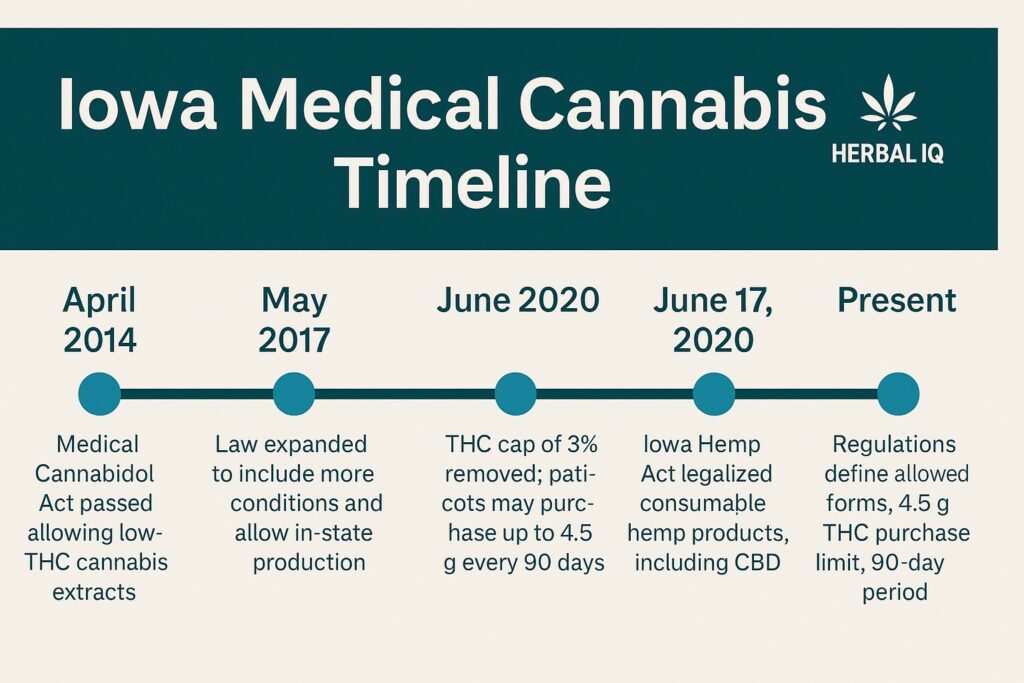
Iowa’s Timeline
- 1921: Iowa classifies cannabis as a “habit-forming drug” but still acknowledges accepted medical use.
- 1971: Iowa mirrors federal law and declares cannabis has no medical use under the Iowa Controlled Substances Act.
- 2014: Iowa passes a law allowing limited medical use of cannabis extracts.
- 2017: Expanded to authorize manufacturing and distribution of cannabis extracts.
- 2020: The 3% THC cap is lifted, giving patients broader access.
📌 Note: Unlike some states, Iowa has never requested a federal waiver to protect patients under the CSA. Instead, change has come slowly through new state laws.
Federal Shifts: The Bigger Picture
The clash between state and federal law has been ongoing for decades. Here are some milestones:
- 1967: The U.S. signs an international treaty classifying cannabis as having no medical use.
- 1970: Congress passes the CSA, locking cannabis into Schedule I.
- 1996: California legalizes medical cannabis—the first state to do so.
- 2001: Supreme Court rules that “medical necessity” is not a valid defense for cannabis growers.
- 2002: Courts affirm that doctors can recommend cannabis (free speech).
- 2005: Patients cannot grow cannabis for medical use under federal law.
- 2013: The Cole Memo gives states a green light if they run strong regulatory programs.
- 2015–Present: Congress blocks DOJ funding for interfering in state medical cannabis programs.
Iowa vs. Other States
Today, 48 states and several U.S. territories allow some form of medical cannabis. Iowa is among them, but its program remains more restrictive compared to neighbors like Illinois or Missouri.
This uneven system leaves patients caught in the middle: they can be compliant under Iowa law while still violating federal law.
Why Federalism Matters for Patients
Federalism is supposed to protect citizens by dividing power between state and federal governments. But in cannabis policy, that balance is shaky.
- Patients risk federal penalties for following state medical laws.
- Providers operate in a legal gray zone.
- Civil rights concerns arise when people must choose between treatment and legality.
As Justice Clarence Thomas noted in 2021, this “contradictory and unstable state of affairs strains basic principles of federalism and conceals traps for the unwary.”
What This Means for Iowa
Forcing patients to choose between their health and the law undermines trust and safety. Iowa has made progress, but without federal reform, patients remain vulnerable.
At the same time, federalism has given states room to innovate and advocacy continues to push lawmakers to bridge the gap between science, policy, and patient needs.
Where Herbal IQ Comes In
At Herbal IQ, we believe knowledge is power. By understanding how cannabis laws developed and where Iowa fits in. You can be part of the movement for better, fairer policies.
We provide:
- Educational resources on cannabis science and law.
- Advocacy tools for patients and providers.
- Community programs that empower people to engage in the policy conversation.
Takeaway
The history of cannabis in Iowa isn’t just about law, it’s about people, health and the right to make informed choices.
Herbal IQ is here to guide you through the complexity and advocate for a future where patients don’t have to choose between wellness and legality.
📢 Your Voice Matters: Stay informed, share this story, and let your lawmakers know that Iowa deserves a cannabis program rooted in science, compassion and fairness.
