
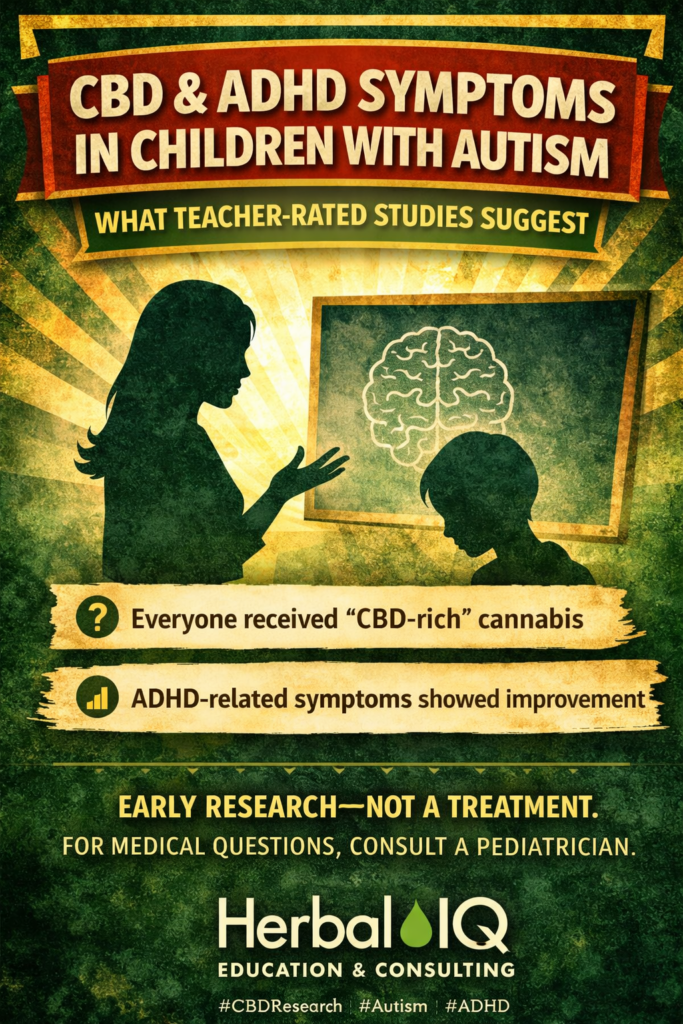
A careful look at a new study using teacher-based assessments
Whenever a headline mixes kids, autism and cannabinoids, I slow down.
Not because the topic shouldn’t be studied, but because it’s easy for people to turn early research into sweeping claims. Families deserve something better than hype or fear. They deserve clear, grounded information. A new study out of Israel, published in Current Neuropharmacology, explored whether a CBD-rich cannabis oil might change ADHD-related symptoms in children and young adults with autism, using teacher ratings instead of relying only on parent reports.
This doesn’t prove cannabis “treats” ADHD or autism. But it does add an interesting piece to the evidence base, and it raises important questions worth studying next.
What the researchers did
This was a prospective, single-arm, open-label study at a single center. In plain language: everyone received the intervention and there was no placebo comparison.
- 109 children and young adults with ASD and ADHD symptoms were recruited
- 53 participants had schoolteacher assessments both before and after treatment
- Treatment period was 3 to 6 months with a CBD-rich cannabis oil-based product
- Teachers used a standardized tool: the Conners’ Teacher Rating Scale (CTRS)
They also collected blood samples to measure cannabinoid and metabolite levels.
What changed (and what didn’t)
The strongest signal reported was improvement in several CTRS categories, including:
- anxious-shyness
- perfectionism
- ADHD index
- emotional lability
- hyperactivity-impulsivity
They also reported additional “trends toward improvement” in other domains such as cognitive inattention and global index measures, although interpreting multiple subscales in an open-label design requires caution. NORML’s summary notes that some outcomes like reduced hyperactivity and better attention showed improvement but may not have reached statistical significance in their reporting.
Dose and blood level insights. One detail that matters for real-world translation: the researchers did not find significant correlations between dosage or blood levels and changes in CTRS scores, except for emotional lability, where higher CBD concentrations predicted greater improvement.
The biggest limitation (and why it matters)
The authors are direct about it: the main limitation is the open-label design.
Without a placebo control, we can’t confidently separate:
- true treatment effects
- expectancy effects
- changes over time
- school environment changes
- other simultaneous therapies
The authors conclude this work supports the need for future clinical trials to validate efficacy and determine optimal dosing.
That’s the responsible takeaway.
What parents and caregivers should know before jumping to conclusions
If this topic is personal for your family, here’s the most honest framing:
- This study suggests possible symptom changes, not proof of treatment.
- Children are not small adults. Dosing, metabolism, side effects and long-term risks need dedicated pediatric research and medical oversight.
- “CBD-rich” is not the same as “CBD-only.” Some CBD-rich cannabis oils may contain other cannabinoids, including THC, depending on formulation and local regulations.
- This should never replace established care. Any consideration of cannabinoids in a pediatric context should be done with a qualified clinician, ideally one experienced in pediatric neurodevelopmental care.
Questions worth asking your clinician (practical and protective)
If a family is considering CBD or cannabinoid products under medical guidance, these questions matter:
- What exact product is being used (certificate of analysis, cannabinoid profile, contaminants)?
- Is there any THC present and at what level?
- What side effects should we watch for (sleep changes, appetite, mood, GI effects, sedation)?
- What drug interactions matter with current medications?
- What outcomes are we tracking, and how will we decide if it’s helping or not?
CTA: Learn with Herbal IQ
If you appreciate careful, evidence-first education, this is exactly what we do at Herbal IQ Education & Consulting.
Membership is where we go deeper than headlines with:
- study breakdowns in plain language
- the “what we know vs what we don’t” clarity that protects families
- safety frameworks, product literacy, and smart questions to bring to clinicians
If you’re a clinician, educator, or caregiver and you want a follow-up, tell me what would help most:
A simple “how to evaluate CBD products” checklist, or a guide on how to read pediatric cannabinoid studies without getting misled.
References
- NORML. CBD-Rich Cannabis Extracts Reduce ADHD Symptoms in Children With Autism (Jan 15, 2026).
- Dana B, et al. CBD-Rich Cannabis Therapy in Children with Autism Spectrum Disorder May Improve Symptoms of Hyperactivity and Attention Deficit: An Open-Label Study. Current Neuropharmacology. (PubMed).
Disclaimer
Educational content only. Not medical advice. This article does not claim CBD or cannabis treats, cures, or prevents autism, ADHD, or any medical condition. Pediatric cannabinoid use should only be considered under guidance of a licensed clinician where legally permitted. If a child is in crisis or at risk, seek immediate professional help.
#HerbalIQ #CBDResearch #AutismEducation #ADHDEducation #CannabinoidScience #PediatricResearch #EvidenceBased #HealthEducation #PublicHealth #ClinicalResearch
