
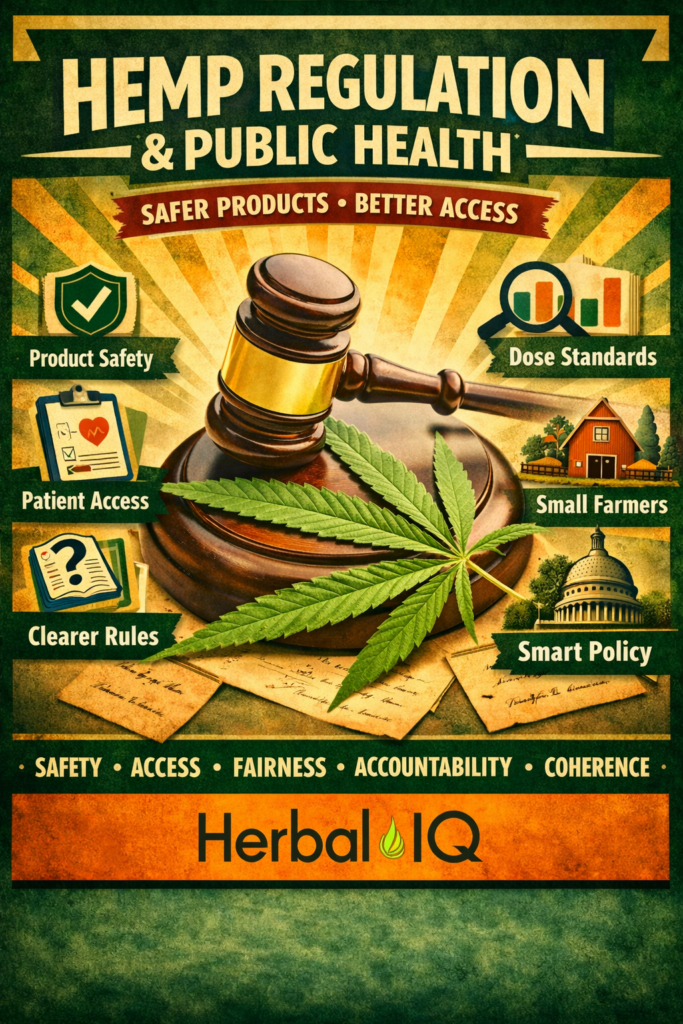
A clinician grounded blueprint for safer products, clearer rules, and better patient access
If you’ve ever tried to explain hemp derived cannabinoids to a customer, a patient, a lawmaker, or even a well meaning friend, you already know the problem:
The marketplace moved faster than the rules.
The result is a confusing mix of products, inconsistent safety standards, and a public debate that often swings between extremes. That’s why a new policy statement from the Society of Cannabis Clinicians (SCC) grabbed my attention.
It’s not written like a press release. It reads like a group of clinicians saying, “We want safety, access, and coherence, but you have to define the rules in a way that actually makes scientific and practical sense.”
Below is the most important content, translated into plain language, with the parts that matter highlighted.
What SCC is responding to
SCC frames this statement as a response to changes tied to the federal Farm Bill language in the FY2026 Agriculture, Rural Development, Food and Drug Administration, and Related Agencies Appropriations Act, and they point to urgent issues around patient access, public safety and regulatory coherence.
In other words, they’re looking at the current federal direction and saying: good momentum, but there are gaps that need immediate clarification.
The heart of the statement
1) Stop blurring “synthetic” with “plant derived”
SCC puts a bright spotlight on synthetic and semi synthetic cannabinoids, calling out risks like toxicity, contamination and unpredictable psychoactivity.
They also acknowledge a nuance that many policymakers miss: a lot of “minor THC isomers” on shelves are commercially produced through chemical conversion, which complicates how we define “synthetic” in real world enforcement. Their answer is straightforward:
Require transparent disclosure of manufacturing methods and create clear scientific criteria to distinguish naturally derived cannabinoids from high risk synthetic or converted compounds.
Why this matters: When consumers can’t tell what they’re buying and regulators can’t clearly define what they’re regulating, everyone loses, especially public health.
2) The 0.4 mg THC per package limit: SCC calls it arbitrary, but not because they want “no limits”
This is a big one.
SCC says the 0.4 mg per package THC limit is arbitrary, unenforceable, and not aligned with clinical or toxicological science.
But they add an important clarification that prevents the conversation from getting hijacked:
Opposing that specific limit does not mean opposing retail dose controls.
They explain why dry weight rules fail for modern product formats like beverages, edibles, and concentrates, where the weight of the product doesn’t reliably reflect psychoactive potential.
Their short term recommendation includes:
- keeping a dry weight threshold, raised to 1%, strictly as a temporary differentiator between hemp and marijuana
- developing product specific dose standards to replace the per package limit
My take: This is one of the most useful parts of the statement because it tries to move the debate from “ban or free for all” to “dose-based standards that match reality.”
3) Protect patient access, but pair it with accountability
SCC warns that restrictions on minor cannabinoids and low dose formulations can jeopardize access to therapies used for symptom control, particularly for medically vulnerable populations.
And they’re careful about optics. They explicitly say access must be tied to clinical accountability, including:
- post market surveillance
- adverse event reporting
- real world evidence collection
This is the clinician mindset: access matters, but the system has to learn from outcomes, not guess.
The structure SCC is advocating for
4) One unified framework, with states implementing on top of federal baseline
SCC supports a unified regulatory framework for all cannabis sectors, including legacy, licensed, and hemp, to reduce confusion and protect public health. At the same time, they affirm state authority.
Their solution is a federal floor model:
- the federal government sets baseline safety, testing, labeling, and age verification requirements
- states implement and build upon those standards based on local needs
This is one of the clearest attempts I’ve seen to reconcile “national clarity” with “state control” without pretending those goals are incompatible.
5) Fairness for small farmers and small businesses
SCC notes that many benefits of current proposals may accrue disproportionately to downstream processors. They call for:
- farm gate protections
- cooperative processing infrastructure
- equitable licensing to help small cultivators participate meaningfully
They also warn that any THC standard should not inadvertently tilt the market toward large scale industrial processors.
If you care about local hemp economics, this section is worth reading twice.
Long term vision
6) Descheduling, but with realistic expectations
SCC supports removing cannabis from the Controlled Substances Act, but they’re explicit:
Descheduling does not mean deregulation.
They argue descheduling could increase federal oversight by shifting cannabis into frameworks similar to alcohol, tobacco, pharmaceuticals, or dietary supplements and they emphasize the need to be precise about what kind of regulation we actually want.
They also call the hemp marijuana split a transitional strategy until a unified framework exists.
What this means for the real world
Here’s what I think this statement gets right:
- Consumers need safer products and clearer labeling
- Clinicians need a system that can track outcomes and adverse events
- Regulators need definitions that reflect modern manufacturing reality
- Businesses need rules that are enforceable and fair, not arbitrary
- Public health needs dose-based guardrails, not weight-based illusions
This is not a pro-industry or anti-industry statement. It’s a “stop pretending confusion is a policy” statement.
Call to Action
If you want to keep up with hemp policy changes without getting buried in noise, this is exactly the kind of document worth following.
At Herbal IQ Education & Consulting, our job is to translate policy and science into practical understanding people can actually use: consumers, retailers, advocates and clinicians.
If you’d like, become a member and you’ll get:
- simplified policy breakdowns like this
- public health focused cannabinoid education
- and templates for communicating responsibly with your community
If you’re a retailer, clinician, or advocate, message me the question you get asked most about hemp right now. I’ll build a short FAQ around the top themes.
References
Society of Cannabis Clinicians. Policy Statement on Hemp Regulation and Public Health (Feb 25, 2026).
Disclaimer
Educational content only. Not legal or medical advice. Regulations vary by jurisdiction and may change. Always consult qualified legal counsel for compliance questions and a licensed clinician for personal medical decisions.
SEO Keywords and Hashtags
SEO keywords: hemp regulation public health, hemp derived THC policy, synthetic cannabinoids risk, THC dose limits hemp, labeling testing age verification hemp, product specific dosing standards, adverse event reporting cannabinoids
Hashtags:
#HerbalIQ #HempRegulation #PublicHealth #CannabisPolicy #HempDerivedTHC #CannabinoidScience #PatientSafety #EvidenceBased #HealthEducation #HarmReduction
Top of Form
Bottom of Form
