
If you’ve worked in cannabis long enough, you’ve heard this line a hundred times:
“Cannabis is anti-inflammatory.”
Sometimes it’s said with confidence. Sometimes it’s slapped on a label. Sometimes it’s whispered like the answer to everything from sore knees to world peace.
But the immune system has never cared about slogans.
A major 2026 systematic review and meta-analysis looked at human studies linking regular cannabinoid use with inflammatory biomarkers and found something that will make both the hype crowd and the fear crowd equally uncomfortable:
Regular cannabinoid use was associated with higher levels of both anti-inflammatory and pro-inflammatory biomarkers.
Not either/or. Both/and.
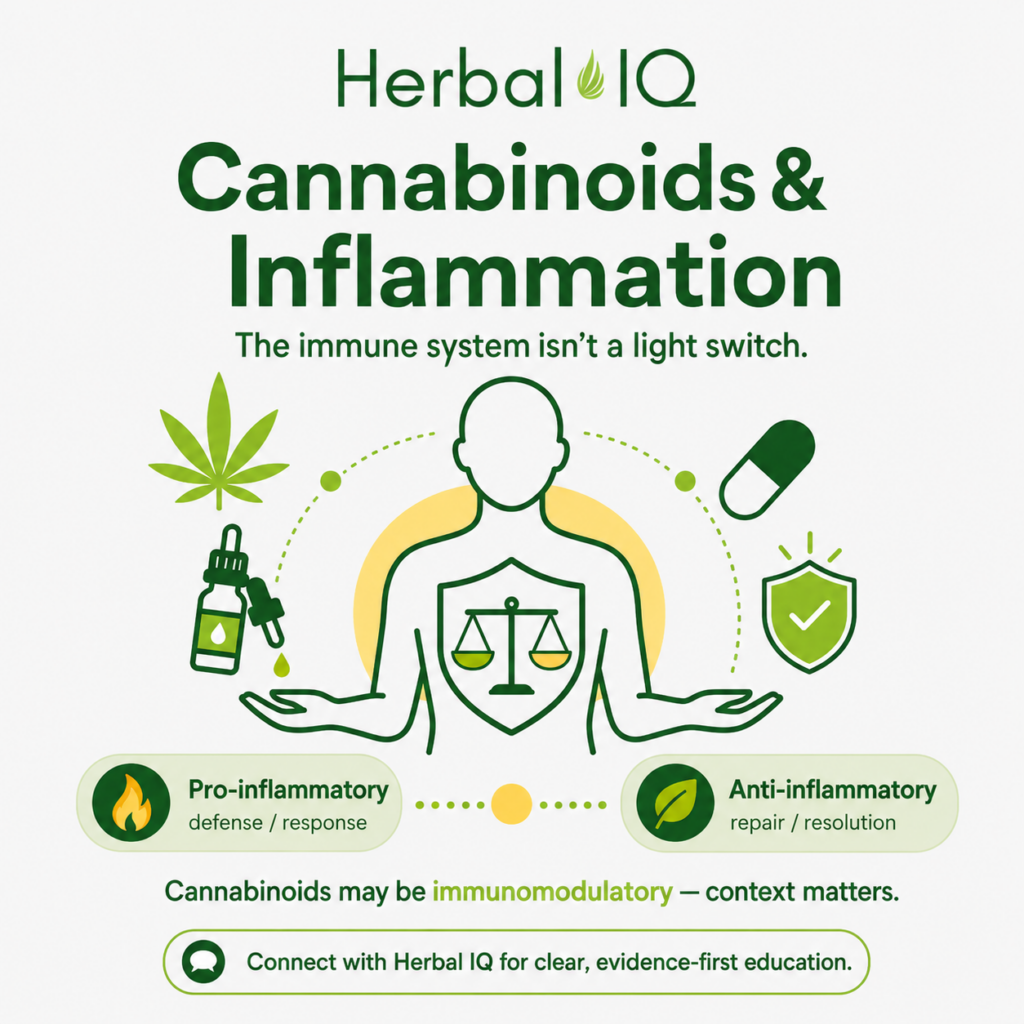
And honestly? That’s exactly what you’d expect if cannabinoids are doing what many scientists believe they do best: modulating the immune system, not flipping it “off.”
Quick laugh, then back to science
If the immune system were a light switch, life would be easy. It’s not. It’s more like a thermostat that’s connected to a smoke alarm… while a toddler occasionally pushes buttons.
So let’s talk about what this review actually means in the real world.
What the review did
The authors pulled together dozens of human studies comparing inflammatory biomarkers between cannabinoid users and non-users, then synthesized the findings across many different markers.
The goal wasn’t to “prove cannabis is good” or “prove cannabis is bad.” It was to clean up a messy research landscape and ask a more honest question:
What patterns show up in real people, measured with real lab markers?
What they found (plain language)
Here’s the core pattern:
1) Observational studies showed “both directions”
Across observational studies, cannabinoid use was associated with higher anti-inflammatory signals and higher pro-inflammatory signals.
That sounds contradictory until you remember something basic about immunology:
The immune system doesn’t do one thing at a time.
It balances defense, repair, signaling, and adaptation, often simultaneously.
2) Recency mattered
Recent use tended to show stronger biomarker differences than past use, suggesting timing and active exposure matter.
3) Synthetic cannabinoids looked different
The review reported larger inflammatory effects associated with synthetic cannabinoids than with plant cannabis. That’s a public health and product-category point worth sitting with.
4) CBD RCTs in healthy people didn’t match the “always anti-inflammatory” narrative
Short-term randomized trials (mostly CBD in healthy people) leaned toward small shifts that don’t cleanly support the simplistic “CBD equals anti-inflammatory” story.
The “so what” for cannabis professionals
If you’re a retailer, educator, brand, clinician, or compliance lead, this review is basically waving a flag and saying:
Stop using inflammation like a marketing villain.
Inflammation isn’t always bad. It’s also healing and immune defense. The goal is not “no inflammation.” The goal is appropriate inflammation at the right time, in the right direction.
Start using the right word: immunomodulation.
If you want language that’s honest, professional, and defensible, this is it:
Copy-paste talking point:
“Cannabinoids appear to be immunomodulatory, meaning their effects can shift depending on the product, the dose, the person, and the context.”
That line alone will make your education better and your risk lower.
Myth vs Reality (this is the part to train your team on)
Myth: “Cannabis is anti-inflammatory.”
Reality: Human biomarker data shows mixed signals. Context matters, and some markers move in both directions.
Myth: “CBD is always anti-inflammatory, so it’s automatically safe and simple.”
Reality: Short-term RCT data in healthy humans doesn’t support blanket claims.
Myth: “All cannabinoids are basically the same.”
Reality: Product category matters. Natural cannabis, CBD isolates, and synthetic or converted cannabinoids are not interchangeable.
A quick compliance note (because this is where pros live)
This review is a gift if you’re trying to stay responsible and compliant.
Instead of “anti-inflammatory” claims that drift toward medical territory, the safer and more accurate lane is:
- education about immune balance
- emphasizing variability and context
- staying away from disease claims
- encouraging people to consult licensed clinicians for medical decisions
That’s not boring. That’s credibility.
What I’d ask next (and what I hope researchers study)
The review raises better questions than most marketing copy ever will:
- Which markers change with THC-forward vs CBD-forward products?
- What happens with dose, frequency, and route of use?
- Do these biomarker changes translate into real clinical outcomes, or are they just signals?
- How much of the association is explained by lifestyle factors (sleep, alcohol, nicotine, BMI, stress, meds)?
If we want clarity, we need research that matches real-world patterns.
Soft CTA (warm, motivational, not salesy)
If you’re building a program, training staff, writing content, or just trying to explain this topic without stepping into hype or compliance risk, you don’t have to sort through it alone.
Reach out to Herbal IQ anytime. I’m happy to help you translate studies like this into clear, responsible talking points and education that your audience can actually trust.
And if you want ongoing breakdowns like this, consider becoming a Herbal IQ member. That’s where we go deeper, keep up with the research, and turn complexity into practical understanding.
If you message me “INFLAMMATION,” I’ll send you a simple one-page staff cheat sheet on responsible inflammation language and common claim pitfalls.
Question for engagement (built for pros)
What’s the most common “anti-inflammatory” claim you hear in retail or marketing that you wish was phrased more responsibly?
References
PsyPost summary of the review: https://www.psypost.org/cannabinoid-use-is-linked-to-both-pro-and-anti-inflammatory-effects-massive-review-finds/
Primary paper discussed: Brain, Behavior, and Immunity (2026) systematic review/meta-analysis (as referenced in the article)
Disclaimer
Educational content only. Not medical advice. This article discusses research on inflammatory biomarkers and does not claim that cannabis, THC, CBD, or any cannabinoid treats, cures, or prevents disease. Individual responses vary. Follow local laws and consult a licensed clinician for medical decisions.
#HerbalIQ #CannabinoidScience #Inflammation #ImmuneSystem #Immunomodulation #EndocannabinoidSystem #CBD #THC #MedicalCannabis #CannabisEducation #PublicHealth #EvidenceBased

